
 |
|
|

|
|
|
Eng - News
Russians to Fuel Iranian Reactor17.08.10 07:59
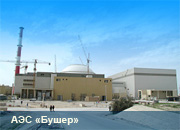 Russia said it would begin loading nuclear fuel into Iran's Bushehr nuclear-power plant on Aug. 21, marking a crucial final step towards making Tehran a nuclear power. Russia said it would begin loading nuclear fuel into Iran's Bushehr nuclear-power plant on Aug. 21, marking a crucial final step towards making Tehran a nuclear power.
The Obama administration, which has previously been critical of Moscow's role in Bushehr, largely voiced support for the Russian position Friday. It's part of Washington's broader campaign to prevent Tehran from obtaining atomic weapons.
Senior U.S. officials said the White House consented in recent months to Russia pushing forward with Bushehr in order to gain Moscow's support for a fourth round of United Nations sanctions against Iran, which passed in June. Under Russia's agreement with Iran, Moscow will supply all the low-enriched uranium needed to fuel Bushehr. And Russia will also be charged with removing the spent fuel from the reactor and transferring it off Iranian soil. These safeguards, said U.S. officials, coupled with the oversight role to be played by the United Nations nuclear watchdog, the International Atomic Energy Agency, assures that Bushehr's nuclear fuel won't be diverted for military purposes. Bushehr "quite clearly, I think, underscores that Iran does not need its own enrichment capability if its intentions, as it states, are for a peaceful nuclear program," White House spokesman Robert Gibbs said Friday.
"We have forgotten very quickly that just a few years ago this was seen as a very dangerous project," said Henry Sokolski, executive director of Washington's Nonproliferation Policy Education Center. "It's very difficult to ferret out what's illicit from what's okay." If Moscow follows though with its pledge to start Bushehr, Iran will complete a more than 40-year campaign to produce nuclear power. Iran's former monarch, Shah Reza Pahlavi, first moved to develop the site in Bushehr in the 1970s in cooperation with U.S. and European companies. When he was overthrown in 1979, Iran's new Islamist government then contracted with Russian nuclear firms for $1 billion in 1995 to finish developing the reactor in the coastal city of Bushehr. Moscow has repeatedly pledged in recent years to commission the Bushehr reactor, but repeatedly backed off. U.S. officials in both the Bush and Obama administrations believed Moscow was using the power plant to maintain its leverage over Tehran in its nuclear talks with the international community. Russia was also seen as fixated on maintaining its economic interests in Iran.
In its negotiations with Russia over Bushehr, U.S. officials said they have sought out the least harmful position from a nonproliferation standpoint. They decided, ultimately, that gaining Moscow's support on sanctions was more important than preventing Bushehr from moving ahead.
"We consider the opening of the plant when electricity is produced and that will probably take about two months," Mr. Salehi said, according to Iranian news agencies.
In addition to the U.N. sanctions, the European Union approved expansive new penalties in July that forbids any new European investment in Iran's oil-and-gas sector. President Barack Obama, meanwhile, signed into law last month new congressional sanctions that will target any international firms doing business with blacklisted Iranian banks and Tehran's elite military unit, the Islamic Revolutionary Guard Corps. "This is new in that it places at risk something that's very important to every financial institution," which is access to the U.S. banking system, said Stuart Levey, the Treasury's undersecretary for terrorism and financial intelligence.
The Treasury and State Department have been dispatching senior officials across Asia, Europe and Latin American in recent weeks to inform foreign government and companies on the provisions tied to the new U.S. sanctions. Mr. Levey said he was leaving Friday for the Middle East's key banking centers to explain the new sanctions regime on Iran.
Читайте также:
|
|
|
О проекте
Размещение рекламы на портале
Баннеры и логотипы "Energyland.info" |
|